The paradox of inclusivity
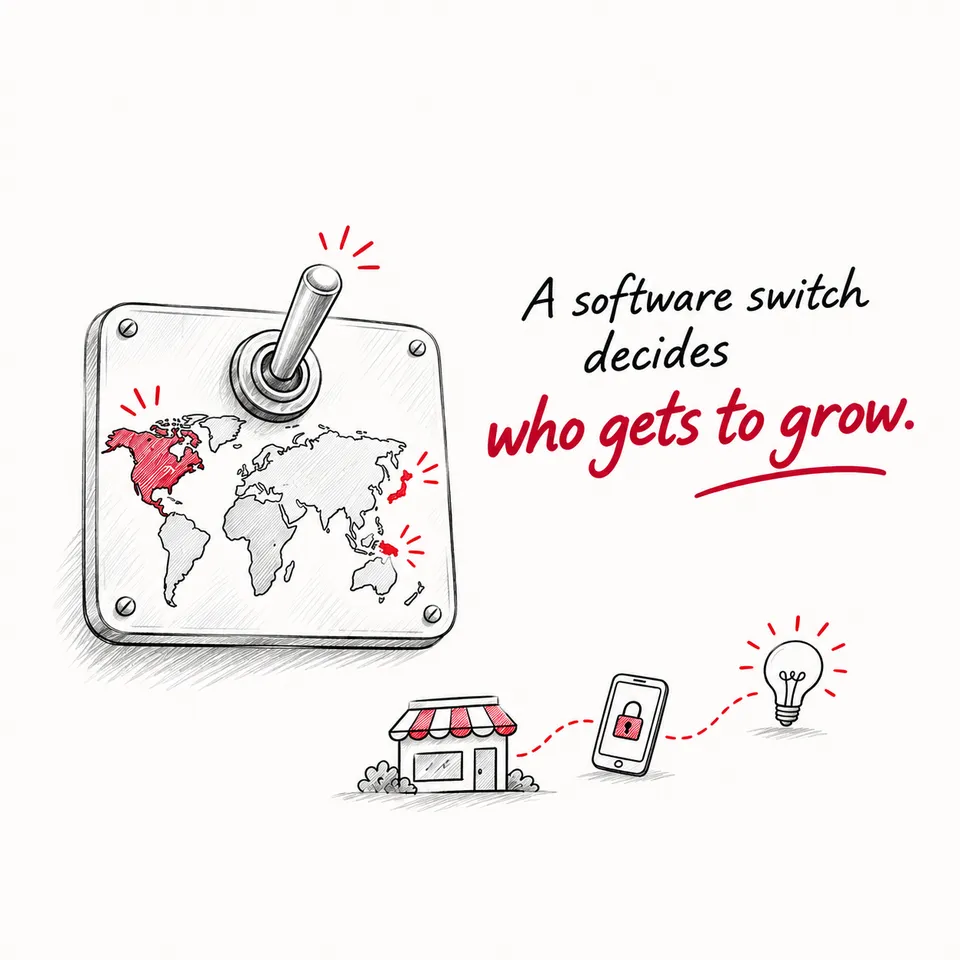
In Professor Abigail Tay's economics class at ASB a few weeks ago, we were talking about market power: how suppliers and customers each push on price and access. Somewhere in that discussion I stopped taking notes. I was thinking about a different kind of market power, the kind where a company decides which countries get to be customers at all.
Take Muse, Meta's new personal AI agent. It launched in September and works in a handful of countries: the US, Canada, Japan, Singapore and a few more since. Nowhere in South Asia. Nowhere in Africa. Or take Apple. Bangladesh still isn't on the country list for an Apple account, so people here can't properly buy an app or pay for iCloud. The usual workaround is borrowing someone else's address.
Now picture a shop owner in Dhaka. Businesses like hers employ about 87% of Bangladesh's workforce and produce roughly a quarter of its GDP. Meta even pitches Muse to small businesses. Her counterpart in Vietnam or Singapore gets an agent that answers customers and runs her ads. She gets a line saying Muse isn't available in her country or region yet.
The numbers on what she is missing are already in. In India, the World Economic Forum and BCG-FICCI both estimate that AI could unlock over $500 billion for the country's 64 million small businesses, and early pilots there showed up to 20% higher productivity and 30% lower costs.
Anthropic's data finds AI adoption tracks GDP per capita almost country by country. Economists at the BIS reach the same place from the other end: emerging economies will gain less from generative AI than rich ones, and the gap between countries could widen. Some of that is infrastructure and skills, which take years to build. Some of it is a switch on a settings page.
Every founder decides where to launch first. I get that. But when the queue starts and ends in the same places every time, a rollout plan starts to look like a map of who gets to grow.
So where should platforms draw the line on inclusivity? I don't have a neat answer. I'd just like the people drawing it to look at who is standing on the other side.
Sources
- Where Is Meta Muse Available? Countries and Rollout (Carly, Nov 2026)
- Apple Community: Bangladesh not listed as a country/region
- Bring Apple Media Services to Bangladesh (petition, July 2026)
- Unlocking the potential of small and medium-sized businesses in Bangladesh (ILO)
- Generative AI at Work (Brynjolfsson, Li and Raymond, NBER Working Paper 31161)
- Transforming Small Businesses: An AI Playbook for India's MSMEs (World Economic Forum, 2025)
- AI adoption in India's 64 mn MSMEs can unlock over $500 bn economic value (BCGX-FICCI report coverage)
- AI adoption in MSMEs can unlock up to $685B potential (YourStory, on the WEF pilots)
- India Country Brief: The Anthropic Economic Index (Anthropic, Feb 2026)
- Anthropic Economic Index report: Economic primitives (Anthropic, Jan 2026)
- Artificial intelligence and growth in advanced and emerging economies: short-run impact (BIS Working Paper 1321, Dec 2025)